
Who Framed Philip Pullman?
Wednesday 11th of August, 2021

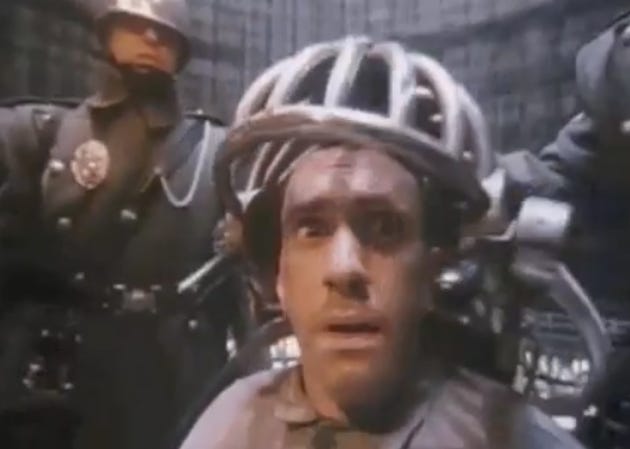
This week, The Society of Authors decided to stop using Twitter/X. Five years ago, it was posting several times a day, and so was the Chair of its Management Committee, Joanne Harris. This post takes us back to those days, to the height of my cancellation on Wednesday the 11th of August 2021 at 8.30 am.
We are in Joanne Harris’ famous writing shed. First she sends the gif above, from the film Brazil, to her friend Neil Gaiman. Then she tweets about the Shed, which today
“ is an apothecary, with shelves filled with bottles and great glass jars of tinctures and teas and infusions and poisons “
Something is indeed cooking. Just yesterday, Harris might have thought herself a little in the wars. On Monday evening, she’d posted a tweet implying that the President of the Society of Authors, Philip Pullman, had caused Chimene Suleyman, Monisha Rajesh and Sunny Singh to be racially abused online. She’d hadn’t consulted the Management Committee about it. One could imagine one or two them might be miffed.
But this morning, the Bookseller will publish an article in Harris’ support. Here it comes, 9.30. The title is SoA distances itself from president Pullman over Clanchy comments. Harris promptly retweets it with her new favourite oxymoron for introducing a conversation on Twitter: Not all conversations happen on Twitter.
The article is all about Twitter, of course. It draws from a leaked letter written by Harris and SOA CEO Nicola Solomon to the Management Committee. The letter isn’t explaining why Harris accused Pullman of a crime though. Rather, according to the Bookseller, it ‘came after’ (Prof Sunny) ‘Singh questioned online why no one in the SoA aside from Harris had spoken out in the defence of her and fellow critics, or why no one had tried to rein in Pullman’. The existence of racial abuse against the three women is reported as fact: the Bookseller isn’t an investigative paper, so I assume they leant on the leaked letter for corroboration.
Shortly after this, because of the leaking, the SOA published the letter in full on the SOA website, and by 3pm the Guardian ran a story about it featuring an interview with Harris. This article went even further. It didn’t just say the abuse was a fact, it implied there was causation between it and Pullman’s tweet: Authors of colour who criticised Clanchy, including Chimene Suleyman, Monisha Rajesh and Sunny Singh, went on to receive racist abuse from social media users. Within the week this version, with causation, will be on Wikipedia. History, a poisonous version, is what is being boiled up in that apothecary.
The Guardian is a paper of record and usually investigates its stories. In this case, though, - as I discovered during exhaustive correspondence - it did not. It relied on the Bookseller and the Society of Authors. Fair enough, you might think. The SOA is an internationally respected organization whose expertise, it says in that very letter, lies in the small print.
But there is something odd about the letter, if you can bring yourself to look at it closely. It’s not much like a letter addressed to a committee for their consideration. It has a formal, general tone. And it’s hard to understand why basic facts would have to be explained to the management committee: for example, that Philip Pullman is halfway through his second and final five-year term as SoA President. President is an honorary position only: he does not play any part in the governance of the SoA (Joanne Harris is the Chair of the democratically elected Management Committee, who set our strategic direction). It reads much more like an agreed public statement.
But it wasn’t agreed. The Management Committee hadn’t had a chance to discuss it and some of them, as they have told me since, didn’t like it at all. They didn’t see why the SOA had entered this Twitter dispute or why Philip Pullman, their diligent, kind, generous, public spirited President, should be condemned for what were plainly - Pullman unlike Harris never put SOA information in his bio - private comments. Harris and Solomon would likely have been aware of that potential opposition when they sent out their letter. Whoever leaked it so very rapidly to the Bookseller did Harris a large reputational favour: the letter effectively skipped a stage to become public policy. We can only speculate who the leaker might be.
The leaking also meant that the letter appeared to be fact checked to SOA standards. The Bookseller and the Guardian certainly assumed it had. But, again, it had skipped a stage. The SOA never – and again this comes from exhaustive inquiries – asked Singh, Suleyman, Rajesh or anyone else for any proof of the abuse said to be caused by Pullman’s tweet. In fact, as I have written here, after lengthy investigations, I don’t believe there was any abuse, let alone causation, to be found. I fear the whole thing was a canard: a fantasy whipped up on Twitter, the very last thing the Society of Authors should have endorsed.
The consequences of it all are still visible today: the Society of Authors no longer has a President. Until they apologise to Sir Philip Pullman it’s hard to imagine how they ever will. A first step would be removing the statement/letter which is still on the Society of Authors website, as dreary and weaselly as the day it was composed. In the week that the Society of Authors withdrew from Twitter/X it stands a monument to the extreme foolishness of those times. For all the bombast in the opening about serious conversations, the link in the middle takes us to tweets that show us just how degraded the discourse really was. Philip Pullman has replied to Sunny Singh that he does not care for ‘policing the imagination’. She writes.
Making it very clear: I am not asking for tesignations or firing or end of contracts (I also know it won’t happen. The powerful always have impunity). I AM asking publishing to confront their complicity and collusion. Esp those like @Soc_of_Authors who like to talk DEII have though all weekend about these tweets and given the alacrity and full throatedness with which @Soc_of_Authors bigwig stepped up to support Cl*nchy, a lot of reflection is needed. Shout out to @Joannechocolat who has been brilliant.
(sic)
It’s as though Autism as a Disability isn’t a protected characteristics under the Equality Act. Or perhaps just not one shared by the right people.
I read the final Book of Dust with great disappointment a few months ago. I am sure that if none of the above had happened it would be a better, clearer and more honest book. We are all the poorer for it.