

‘A learning moment’ is one of those phrases so abused in the culture wars that it has become almost impossible to use. ‘A humiliation moment’ is what it generally means. A gloating hour.
There were plenty of those for me during my cancellation. I also, though, genuinely learned a thing: what suicidal ideation means. As a teacher, I’d sat with many young people talking about this feeling. My father suffered with clinical depression so for years it was part of our family life, but I’d never experienced it for myself. All at once I understood it was not a wish but a drive – a force like thirst or hunger, or l’appel du vid, the weird desire to jump off the ledge I experience with vertigo.
‘L‘appel du vid’ is a misplaced brain signal, a response to danger bouncing down the wrong neural pathway. It is disquieting because the conscious mind rebels against it yet the drive strongly persists. This new urge to destroy myself felt similar: unnatural, yet powerful. Implanted, was the word that kept occurring to me: not my own. It stemmed from the abuse directed to me in an annoyingly simplistic way. It was absurd, I thought, how primitively magical words were, how strongly I wished to die simply because I was receiving messages like this one.
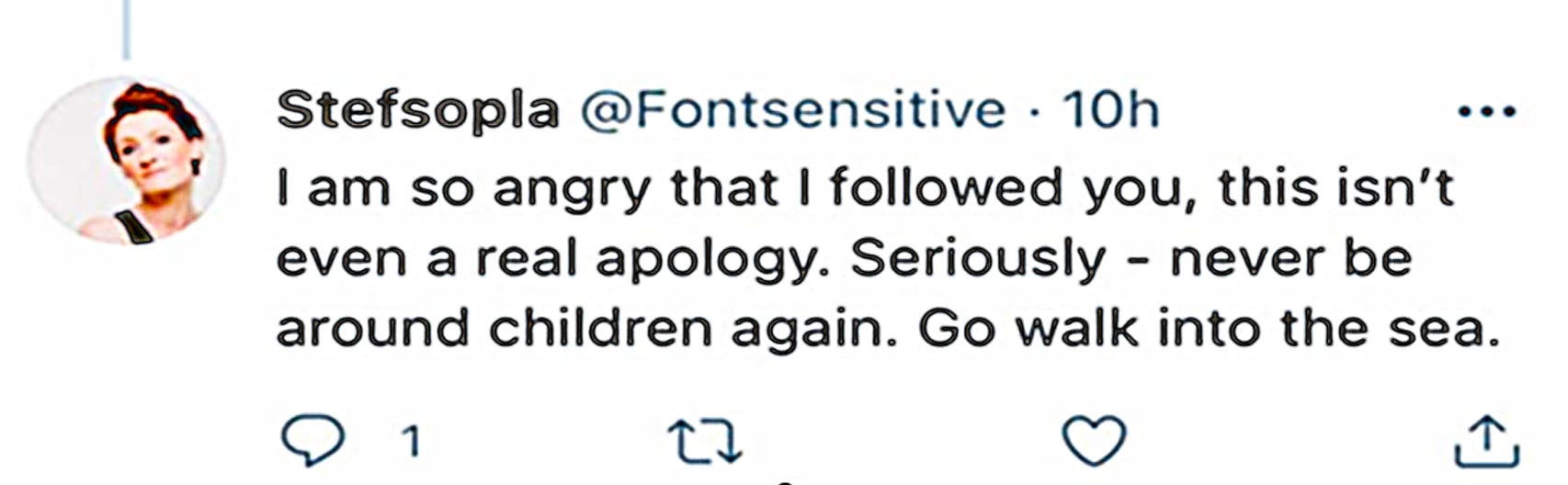
Soon I became enraged by the feeling. I’d suffered greatly as a young woman from the pressure of my father’s suicidality: I was damned if I’d pass that on to my children. I also felt impelled to act in some way. This urge must, I thought, be a common result of the new social media harassment. There must be something I could do to stop it, for myself and others.
I did some reading. I found lots of evidence that suicidality and workplace bullying were connected. I thought I could try to explain at least that much to my publishers, Macmillan. They were all about mental health these days. So I wrote to them, carefully and sincerely. I asked them to try to make me safer. We even had a meeting about it. Then an invitation came from Prospect magazine to write 600 words on cancellation, and I made the dangers of suicidal ideation my theme.
You can read the article here. You’ll note it’s passionate but also careful. It’s about the social force of ostracism, not individuals. It is not in any way, even by implication, about my publishers, so neither I nor Prospect - a punctilious publication - thought it necessary to show it to them.
But, in the week before the article was published, an interview supportive of me with Philip Gwyn Jones, Publisher of Picador, (Picador is an imprint within Macmillan) appeared in the Telegraph. Macmillan rapidly forced him into a degrading public apology (as I wrote here). My agent grew nervous and told me I should send the Prospect piece to Macmillan in advance. So I did.
Immediately, Macmillan asked me to withdraw it. I thought that was unreasonable and refused. At first, the Macmillan Head of Comms backed me up. She pointed out to her colleagues that I’d been offered high profile interviews and hadn’t taken them, and that this was a personal piece unlikely to gain traction. Philip Gwyn Jones added that I had a right to do it. Those were rational responses. Controlling writers’ journalism had never been a publisher’s remit.
That was Monday. By Wednesday, when the Prospect article came out, Macmillan had decided to return the rights to all eleven of my books - that is, to stop publishing them and publicly severe the connection between us, an unprecedented action in any publishing company - over these same 600 words. ‘DIVORCE’ they wrote joyfully, ‘it’s the only way.’
That decision, it seems fair to say, was a poor one for Macmillan’s long-term PR. It haunts them five years later. So how did it come about? How did they turn a molehill into a mountain?
Well, the aftermath of that Telegraph interview with Gwyn Jones was an important factor. Macmillan had set a sort of scapegoating machine going in order to focus blame on Gwyn Jones, and it was still turning, and looking for new grist, a week later. A special ‘social listening service’ was continually sending the Head of Comms portentous graphs and graphics.
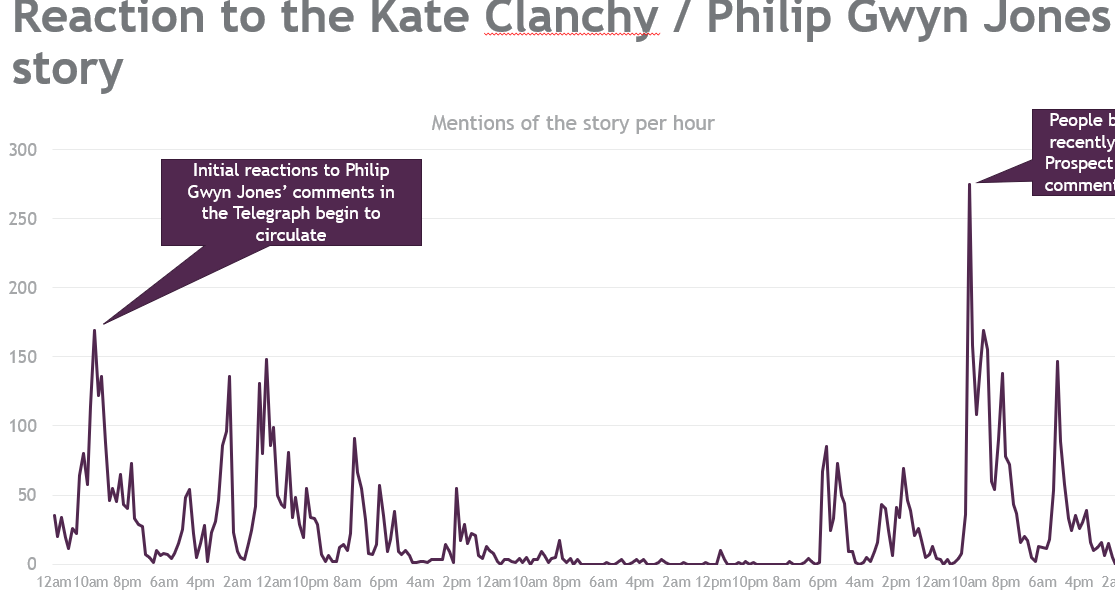
There was internal demand for punishment too. ‘Young staff’ had been surveyed for the Gwyn Jones affair and mandated ‘concrete action’. Now Gwyn Jones had been pilloried, more was wanted.
Then there was Brenda, my traitorous publicist. This was all her scheme to start with. She was at her most Iago-like as she nagged the Head of Comms about the Prospect piece which she called an ‘incendiary op-ed’. I was ‘going rogue’ and ‘torpedoing’ Macmillan’s plans. “I’m sick of the woman damaging us,” she wrote, “she constantly ignores our advice which is how we are where we are.”
Soon, the Head of Comms was agreeing with Brenda. (Kate) “won’t listen to reason and isn’t acting rationally.” In their minds I seem to be growing large and important, large enough to threaten the company. “It’s just been striking how quickly people have elided Kate, and Picador in general.”
Now Brenda tried a new tack. She suggested that the Prospect article was a wonderful chance for Macmillan to expose me as a lunatic : “it puts the focus back on Kate’s mental state….one of the big issues is that we haven’t been able to say ‘we are dealing with an incredibly volatile and difficult person’.”
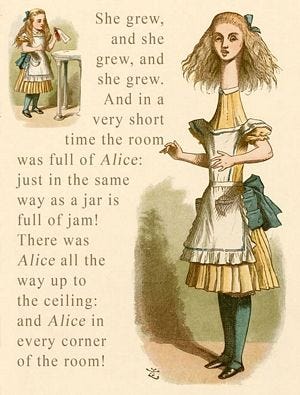
In that analysis I am enormous, filling the room like Alice when she eats the cake. The Prospect article, Brenda urged the Head of Comms, was the chance to show the world that I was the crazed aggressor and little Pan Macmillan the victim. Macmillan could demonstrate how helpless they were when I did things like write sentences. They could say “we tried to stop her at every point but couldn’t.”
The Managing Director leaned in and agreed. For him, I was heavily armed. “I think we need to cut ties with Clanchy who is a loose cannon and destroying our reputation,” he wrote to the CEO.
The CEO. Let’s stop with the CEO because that is where all bucks should stop, and anyway, his response was the most extraordinary of all. He read the words below - I’m putting them in orange quotes because they are a magic spell -
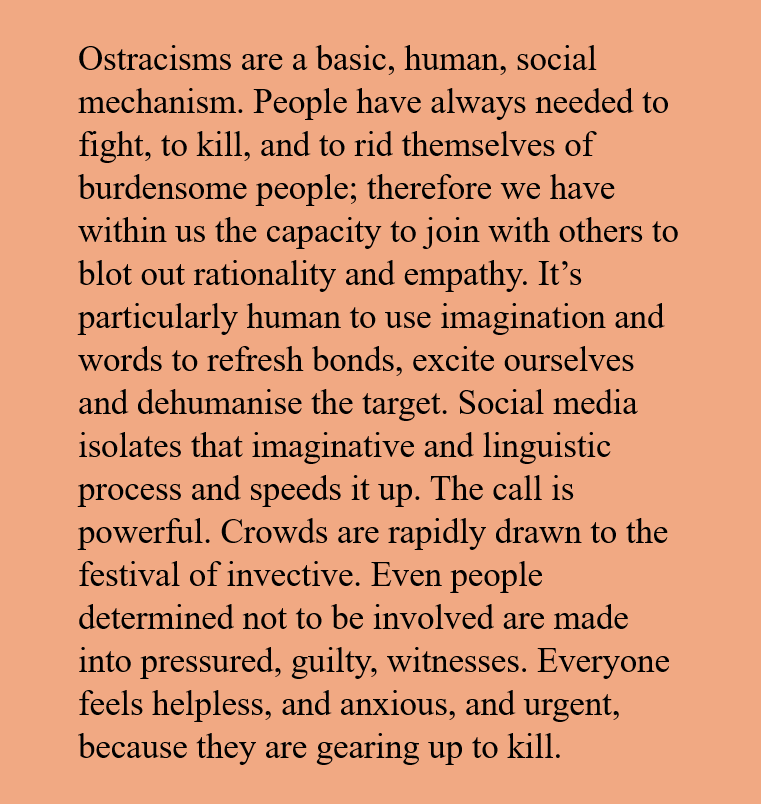
and almost immediately told the MD that my Prospect piece was ‘awful and manipulative’.
Let’s go through that again. The CEO didn’t read any words about his company. He read my very brief account of feeling suicidal, then the orange words above. Did he find them confronting? It seems likely. Did they make him feel shame? Possibly. But
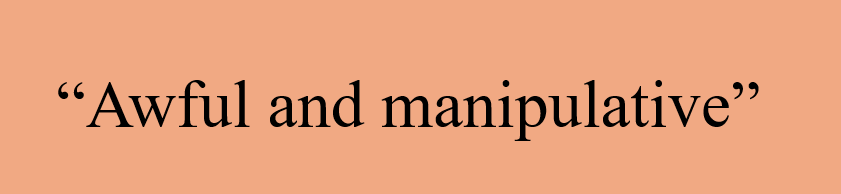
was an irrational response. It was not possible for a single writer to ‘manipulate’ his large company with 600 words in a magazine. He seemed to respond to my analysis of magic spells as if the analysis were a magic spell in itself, one with power over him.
He didn’t just say it once. He repeated his judgement and made it the company line. He pushed for and approved of that egregious public punishment, the return of all my rights.
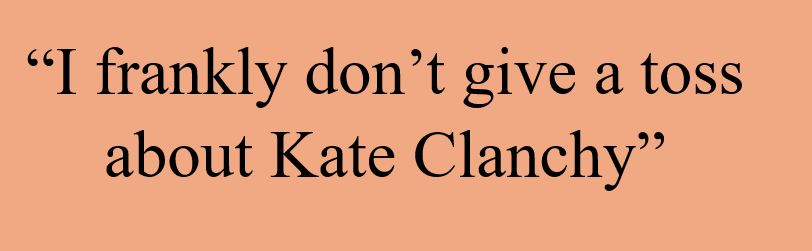
At a ‘town hall meeting ‘ of all Macmillan staff he repeated the ‘manipulative’ angle and also said “I frankly don’t give a toss about Kate Clanchy.” In the context of my article, that feels like a death wish to me. His assembled staff, so well informed about all aspects of mental health and so deeply concerned about abuses of power, applauded it.
This speech was shown beforehand to the Head of Comms, with whom I’d so carefully discussed my suicidality, and also to the head of a visiting PR firm who was qualifying as a child psychotherapist. They must both, at some point, have read something of the dangers of victim-blaming. Yet they both approved of his speech. I’m just going to take the space now to say that makes them both moral idiots.
I’m also going to name the CEO. The man recommending indifference to my death at public meeting of his collected staff was Anthony Forbes Watson. I only met him once. I remember bald, reptilian eyes and one of those, posh, lisping, whispery voices seemingly designed to be unintelligible. My impression, even then, was that he hated me, and no, I don’t know why. I’d never done anything to my publishers except submit manuscripts on time, earn out advances and win awards. Misogynists, though, often react strongly to me because I have a big, motherly, vibe combined with a mocking stare. At that single meeting Forbes Watson impressed me as being one of those.
Forbes Watson was shortly to retire, which may have been part of the reason why he felt free to behave so irresponsibly. The MD has also moved on. Forbes Watson was replaced at Macmillan by Joanna Prior, who, from everything I read and hear, is a kind and wise CEO who has done much to repair and build the company. I was happy to accept her apology for what happened. It had nothing to do with her.
Brenda, though, and many others at that town hall meeting, remain in the company. I know that Picador, as opposed to Macmillan, continue to be satisfied with the way they treated me. In Picador they tell a story where I am still large as Alice after the cake, where I was secretly controlling the whole narrative and also caused international racist abuse. I believe, and believe I have demonstrated, that they were the victims of a hoax. Is there something I am missing? Is there a way to change your minds? If you are a Picador person reading this - I’ve heard you all follow this Substack - perhaps you could let me know. Maybe it could be a learning moment for all of us.
Blimey. We are all indebted to you for surviving this and telling the tale so clearly. Well done.
I think that what you have done here by recording your experience, and how you worked your way through it, is very important. Other people who have been on the end of these public mobbings and emerged defiant are often pushed into a corner and become hyper combative and contrarian. Others disappear. Others kill themselves. I do not think I have read anybody write about this from the inside so thoroughly, with such sensitivity, and such a sense of what is at stake morally. Thank you.